VIDEO: The Bremont Supermarine Type S301
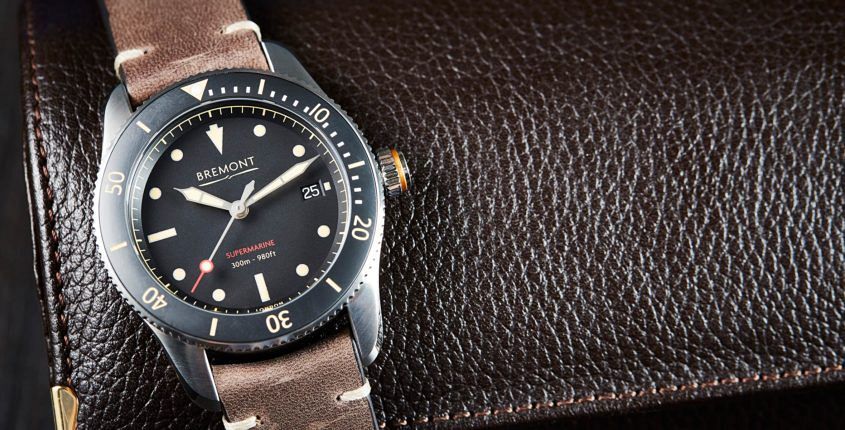 Bremont is a brand fuelled by avgas and the spirit of Icarus. The fledgling British brand has their roots in the sky, as it were. But that doesn’t mean that they’ve neglected other spheres of influence, including motorsports and as we can see here, diving. The Supermarine (even their dive watches have an aviation tie-in) first entered the catalogue in 2010, in the form of the Supermarine 500, a large 43mm steel piece with a distinctive ‘crown-at-two’ case design. This year the Supermarine has evolved, with several new references joining the family — the S300 and the S301. These divers — while still having plenty of Bremont DNA, such as the Trip-Tick case — are much more traditional. They’re smaller, at 40mm across, and slimmer, with a 13mm height. And if the proportions are constrained, so too is the style. The S301 plays the vintage card, with its printed hour markers, lollipop seconds hands and a general air of world-weariness. As with pretty much everything Bremont create, it’s a strong, smart, design that plays to their strengths and is suitable for a lifetime of daily wear. Bremont Supermarine Type S301 Australian pricing Bremont Supermarine Type S301, on leather, $5000
The post VIDEO: The Bremont Supermarine Type S301 appeared first on Time and Tide Watches.
 We’ve been engaging in a little bit of watch personality matching this week, pairing daring divers up with the Pelagos, and dashing sartorialists with the Heritage Black Bay. But what if you sit somewhere between the two? Sporty and casual, but overall, stylish. Well, by now it should come as absolutely no surprise that there is a third option. The colourful Heritage Chrono. So, if you want an eminently practical chronograph with more than a splash of colour, this could be the watch for you. And while there’s a more subdued black dialled version, our money is — and always will be — on this seventies-tastic blue and cream number.
 Dive watches, thanks in part to their function-before-form ideology, can often be, well, formulaic. Seiko’s bold gold SSC618P manages to buck the trend in a few ways. Firstly, and most obviously, they’ve dressed up rugged steel with an unmissable rose gold coating, which must surely increase visibility underwater, as it’s certainly eye-catching on land. Then there’s the fact that this is a dive-ready chronograph, a slightly uncommon combination, but it’s always fun to play with screw-down pushers. And finally there’s the fact that while this Seiko isn’t packing mechanical heat in the backend, the movement is a quite interesting (and useful) solar-powered number. Honestly, this is a 43.5mm chunk of summer fun, that would, just quietly, look killer on a khaki nylon strap. Seiko Prospex SSC618P Australian pricing Seiko Prospex SSC618P, $775
 “Which watch should I get?” It’s the first, and hardest, question to answer for any watch lover (shortly followed by “which watch should I get next?”), and our news and reviews aim to make that question easier for you to answer. Well, today we make it simpler yet, with a series of three short videos that each ask, “How do you know which Tudor is right for you?” We match three key watches from Tudor’s catalogue to three styles of wearer, albeit in a slightly tongue-in-cheek way. First up is Tudor’s mighty technical diver, the Pelagos. So, if the above video resonates with you, you might want to check out our longer review. But you’re not completely off the hook — the next tricky question is: Black, Blue or LHD?
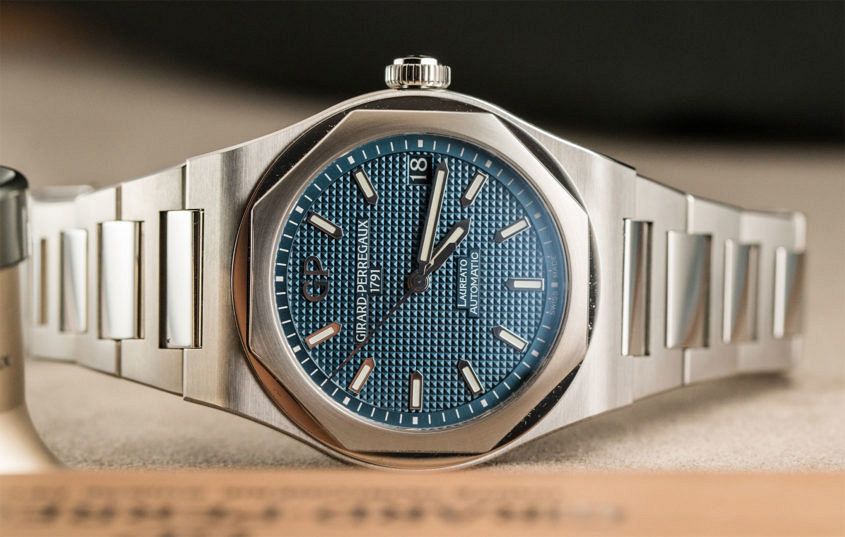 A little while ago, we put together a list of luxury sports watches and it went – to use a technical term – bananas. There’s something about the combination of utility and exclusivity that really appeals to people. And as I look down at the Laureato on my wrist as I type this, I can honestly say, I get it. Sure, tool-like dive watches and sporty chronographs fill a place in our watch-loving hearts that crave functionality and purpose, but a watch like the Laureato offers something more. Purpose and practicality, with ample lashings of beauty. I mean, just look at how that Clous de Paris dial, or those bracelet links, blaze in the light. This watch looks good in pictures, but it comes alive on the wrist. Girard-Perregaux Laureato 42mm Australian Pricing Girard-Perregaux Laureato 42mm, in steel on bracelet, $16,080
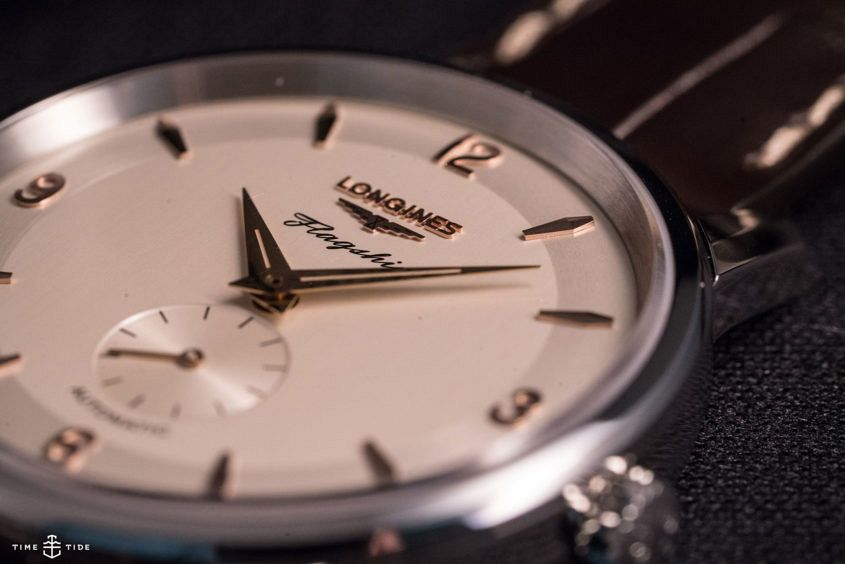 The hardest thing when recreating a vintage watch design is knowing when to stop. Some changes — swapping the plexiglass crystal for sapphire, and upgrading the movement — are logical, and others, like an increase in size to more modern dimensions, make sense. But the real art is knowing where to stop, and what to keep. By that measure, the Longines Flagship Heritage 60th Anniversary is a masterpiece in miniature — 38.5mm to be exact. This size is a perfect case in point: it’s an incremental increase that stays true to the spirit of the original in a way that a 40mm watch would not. Then there’s the dial, which would be hard to distinguish from a 1957 model, not least because there’s no unsightly date window to spoil the luminescent combination silver dial and gold tone markers. And while most people will be interested in the steel version, there are also rose and yellow gold versions — full gold, not plate. Longines Flagship Heritage 60th Anniversary Australian pricing and availability Longines Flagship Heritage 60th Anniversary in steel, $2650, limited to 1957 pieces, in yellow or rose gold, $10,350, limited to 60 pieces per version.
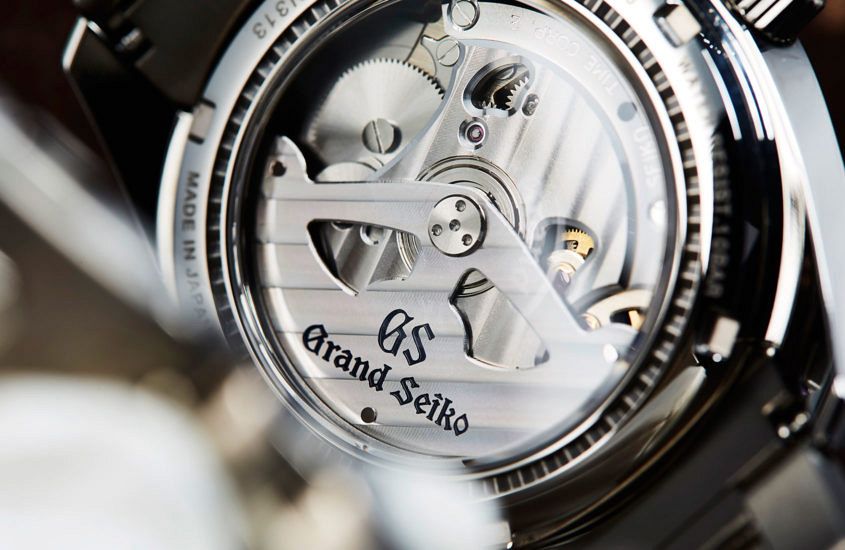 Fundamentally, there’s not a whole lot of variation in watch movements. Sure, the peripheral details might vary, but basically you’re either looking at a purely mechancial movement, with a mainspring and escapement setup that’s remained pretty much unchanged for the last few hundred years, or you’re looking at a battery-powered quartz watch that’s come to dominate mass market timekeeping over the last 50 years. And then there’s a few genuinely novel outliers, technologies such as Zenith’s recently announced Defy Lab and, the one we’re looking at today — Seiko’s Spring Drive technology. Spring Drive had a long gestation. It was first conceived in the late ’70s, but didn’t see a commercial release till 1999. Fundamentally, Spring Drive is a hybrid technology that takes the autonomous, perpetual power capacity of an automatic movement, and melds it with the impressive accuracy of quartz. Like any uncommon technology, it can take a while to get your head around, which is why we’ve put together this handy (and hopefully informative) explainer. Everything you need to know about Spring Drive, in just under two minutes.
 There’s a reason chronographs are one of the most perennially popular watch complications – they add a lot to a watch. Functionality, interesting design elements, and a sense of derring-do, thanks to the chronograph’s close association with the exciting and glamorous worlds of motorsports, aviation and general athletic endeavour. Most importantly though, they add a real sense of tactility, allowing you to interact with – and measure – the passing of time in a meaningful way. And I’ve got to say, I could get used to wearing and using this Raymond Weil Freelancer. The dial and case is a quiet explosion of colour and texture, with a pleasant mix of finishes that not only amp up the dressier aspects of the watch but also ensure that the simple act of checking the time is a mesmerising lightshow. Raymond Weil’s Freelancer Chronograph Automatic Australian pricing Raymond Weil’s Freelancer Chronograph, on leather $3895