
Editorial: Squaring The Circle
Or how square-shaped watches wear in relation to round and rectangular ones.
Or how square-shaped watches wear in relation to round and rectangular ones.

What we have here is nothing especially new or highly innovative… However, it certainly is one very cool edition of one of the most iconic racing chronographs ever: the TAG Heuer Monaco Calibre 11 – you know, the watch worn by the “King of Cool”, Steve McQueen, in movie Le Mans. Made especially for the French market (without a single reference to France in its design), very limited in production, and with a dial that recalls a certain “Dark Lord”, here is the TAG Heuer Monaco Calibre 11 France Edition.
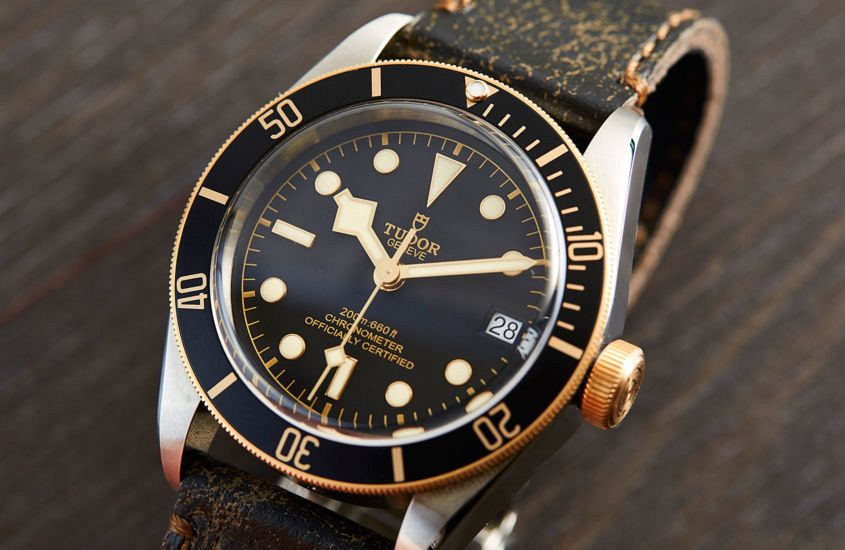 The story in a second: Two-tone is back, baby! Steel and gold watches have been around for years. Hitting peak popularity around 30 years ago, they were the epitome of ’80s style, but, then again, so were pastel polos with double popped collars. However, while the mix of these two metals has been used by countless manufacturers, I’ve just never been a two-tone guy. It’s not that I have anything against the combination (double popped collars are a different story), it’s just that they were never for me. This year, something happened that I think no one saw coming. Tudor released a two-toned Black Bay, and, I have to say, I think they’ve changed my mind. The case Apart from the obvious, not much has changed with the 41mm case of the new Black Bay. It still holds that same classic tool watch shape, with high, polished sides, chamfered lugs, and oversized crown. On top, the satin-brushed finish is still there, as is the black 60-minute bezel, which surrounds that wonderfully domed sapphire crystal. It’s even still water resistant to 200 metres. What has been changed, though, makes all the difference. The bezel is now a solid piece of yellow…
The post IN-DEPTH: The Tudor Heritage Black Bay S&G appeared first on Time and Tide Watches.

The slump is over. Deloitte says Swiss watch executives are bullish (despite the Trump factor).

Oh, and Paul Newman’s Paul Newman.
A new GMT timepiece from Ball Watches, with their signature always-on tritium dial.

The Reverso certainly is the most iconic watch of Jaeger-LeCoultre. Of course, most of us know its long and rich history, with its roots linked to British polo players asking for a protected watch and its subsequent creation in 1931. There’s one thing that this particular construction allowed: personalisation. Today, the back of this classical Jaeger-LeCoultre Reverso is a field of expression to celebrate a double centenary: the birth 100 years ago of Dutch art school De Stijl (think Piet Mondriaan) and of Dutch retailer Steltman. Here is the specifically-adorned Reverso Tribute to Piet Mondriaan.

Just when you thought you had seen it all, these two guys show up.

Since its inception in 2010, the brand Laurent Ferrier and its signature watch, the Galet, have always been favourites of ours, here at Monochrome. The reasons for that are simple: the design, the elegance, the execution and mainly, the beauty of the movements. Over the years, the collection has seen some evolutions, the most significant …
 First things first, what is sapphire crystal? Essentially, it’s the same stuff used to make a watch ‘glass’ and display casebacks, formed by crystallising aluminium oxide at very high temperatures to create an extremely hard material. Roughly speaking, it mimics what Earth has taken 400 million or so years to do, to form natural sapphire gemstones. For sapphire-cased watches, the middle, bezel and back are milled from solid blocks of the material. Because it’s almost as hard and scratch-resistant as diamond (9 on the Mohs scale, as opposed to 10 for diamond), the task of milling it into the complex shapes required is much more easily said than done. Indeed, sapphire crystal can be cut only by diamond. Harnessing the knowledge it gained from developing a milling technique for Magic Gold (another hugely challenging material), Hublot works with a Swiss specialist as part of an exclusive partnership to develop the sapphire material. Speaking at Baselworld 2016, Ricardo Guadalupe, Hublot’s CEO, said that the rationale for using the material was to show off its in-house calibres – and that would also determine the choice of models that would be given sapphire cases. 1. 2016 MP-05 LaFerrari After 18 months of development…
The post LIST: Ultimate transparency — Hublot’s sapphire evolution, in 13 watches appeared first on Time and Tide Watches.