HANDS-ON: The Franck Muller Cintrée Curvex Jumping Hours Tourbillon
 Earlier this week we showed you Franck Muller’s Skeleton Tourbillon, a sculptural wonder that let the movement shine. Today we’ve got a different take on the tourbillon: the Jumping Hours Tourbillon, which is just as stunning, even if it’s a little less revealing to the casual observer. The first thing you might notice about this watch (OK, the second, after you’ve finished gazing in wonder at the hand-engraved 60-second tourbillon) is that it appears to be missing a hand. The sinewy blued steel minutes are there, but what about the hour? And for that matter, where are the hour markers? The exploded Arabic numerals on the stamped sunray dial display the minutes. Well, the hours are there, displayed in the aperture between Franck Muller and Geneve on the dial. As far as they go, jump hour complications are fairly uncommon, perhaps because the unconventional time display tends to be polarising. I do think Franck Muller missed an opportunity to make their jump hour stand out — the square white disc with plain printed numbers is a dissonant note. I would have liked more, especially on a watch at this level. Turn the heavy platinum case over and you’re met with…
The post HANDS-ON: The Franck Muller Cintrée Curvex Jumping Hours Tourbillon appeared first on Time and Tide Watches.


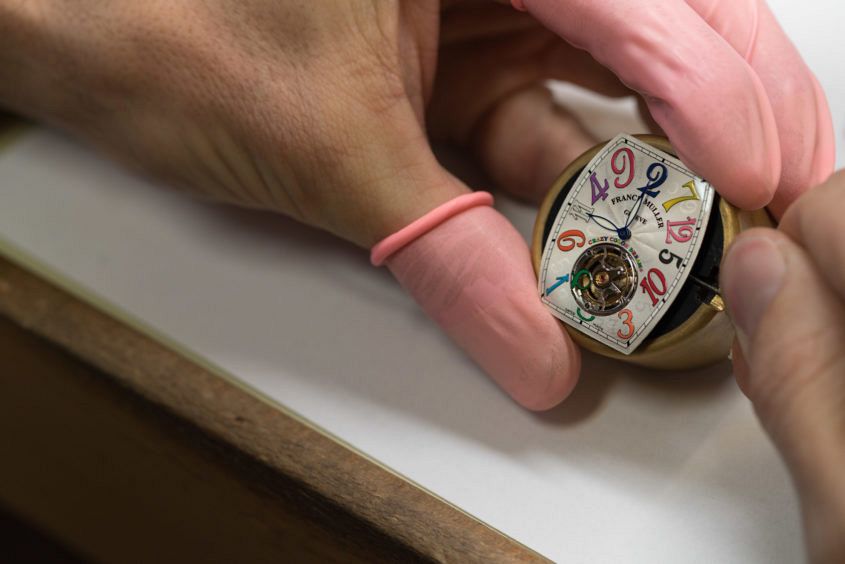 There have been big changes at the Franck Muller manufacture over the last couple of years. The once homely property on a hillside looking out over Lake Geneva has been thoroughly expanded and modernised – Baroque and Romanesque flourishes inside and out have been updated to the more spacious proportions created by exposed beams and vaulted ceilings, all befitting of a luxurious ski lodge. Somewhere in a light-filled room appointed with watchmaker’s benches in this village of multi-storey buildings is the Franck Muller ‘Tourbillon Department’. The warmest thing in this room, no matter the time of year, is Patrice Couston’s smile. He is the head of the Department and his passion for what he does is unmistakeable. To the extent that, after a tour and his explanation of some of the challenges faced in by one attempting to assemble a tourbillon, he reached into his pocket and pulled out a watch he had assembled in his spare time at home, also a tourbillon. “I’m crazy for the tourbillon so I said ok, I will transform this movement into a tourbillon. So I did.”
 Until its relaunch earlier this year, the IWC Da Vinci collection was sometimes overlooked, and unfairly so, as it has housed several “firsts” for the company. First introduced in 1969, it was the first watch from the Schaffhausen manufacturer to feature a quartz movement – the famous Beta 21 – which was the product of a collaboration between 21 of the top Swiss houses, including Omega and Patek Philippe. Then, in 1985 the collection was given new life with the release of the awe-inspiring Da Vinci Perpetual Calendar (ref. 3750). Equipped with a perpetual calendar module developed by IWC’s renowned master watchmaker, Kurt Klaus – which was installed on a heavily modified Valjoux 7750 chronograph movement – it was the first perpetual calendar movement on which all complications could be set using only the crown. This year, as well as returning to the round case with articulated lugs design of the 1980s, IWC has released a faithful tribute to the iconic ref. 3750 – the Da Vinci Perpetual Calendar Chronograph – which, in another first for the manufacturer, combines the chronograph hours and minutes counters, and a moon-phase complication on a single subdial at 12 o’clock. To achieve this, the engineers at…