RECOMMENDED READING: Should you wear a watch when exercising?
 If you love watches, you probably want to wear them all the time. The past CEO of The Swatch Group Nicolas Hayek was famous for wearing half-a-dozen watches at one time, and even if you aren’t quite that eccentric, you might still feel like you’re missing something when you don’t wear a watch. But this begs the question, should you wear a watch when exercising? There are no hard and fast rules about mechanical watches and exercising, other than personal comfort, and potential damage to the watch. If you are comfortable wearing a watch while you exert yourself, and aren’t concerned about potentially breaking the timepiece, then go for it. If you are slightly more concerned, there are a couple of things you can consider. Risks to a watch could come from impacts, such as knocking it against a weight or jolting it up and down while running. It could also be at risk from moisture getting into the movement of the watch, an event that will reliably stop your watch from functioning any further. Despite these risks, however, there are still some watches that are suitable to be worn in the gym, which Chrono24 go into some detail about…
The post RECOMMENDED READING: Should you wear a watch when exercising? appeared first on Time and Tide Watches.


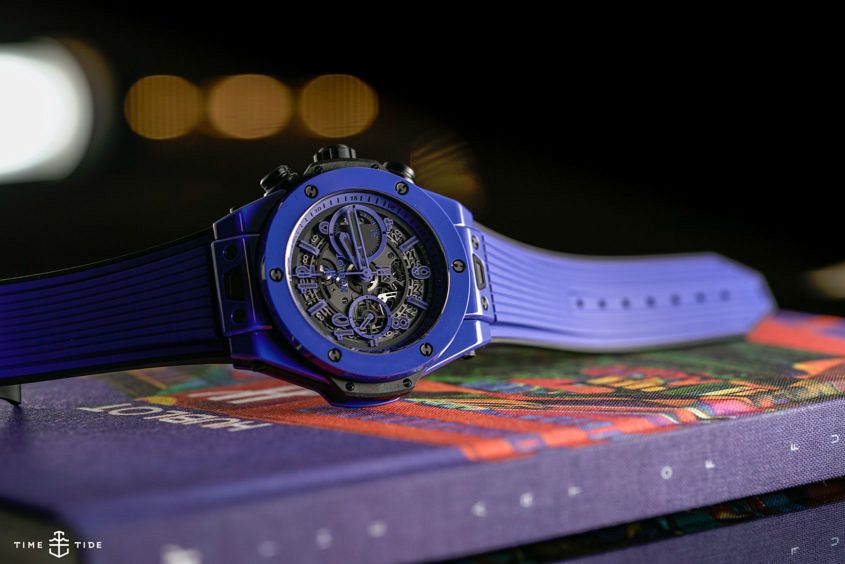 It’s easy to forget or overlook the magnitude of what Hublot has achieved with their materials innovation — the scale and scope of their sapphire pieces is impressive to say the least, and their use of ceramic is amongst the most interesting in the business (which is no small feat given that every brand and its dog is making the most of the material at the moment). What really stands out with Hublot’s ceramic watches is their vivid tones. Last year’s Red Magic was one of the real bright spots (literally), with a hue that no other brand has managed to match. And this year’s Blue Magic doubles down on the trick — the 45mm sports chronograph is an outragesouly, awesomely bright blue. Polished blue ceramic aside, it is business as usual — the open dial, the one-click strap (blue, obvs) and the HUB1242 chronograph movement. This watch is limited to 500 pieces. It’s also a watch that leaves me wondering: what ceramic wonder will Hublot do next? Hublot Big Bang Unico Blue Magic price and availability Hublot Big Bang Unico Blue Magic, limited to 500 pieces, $27,000
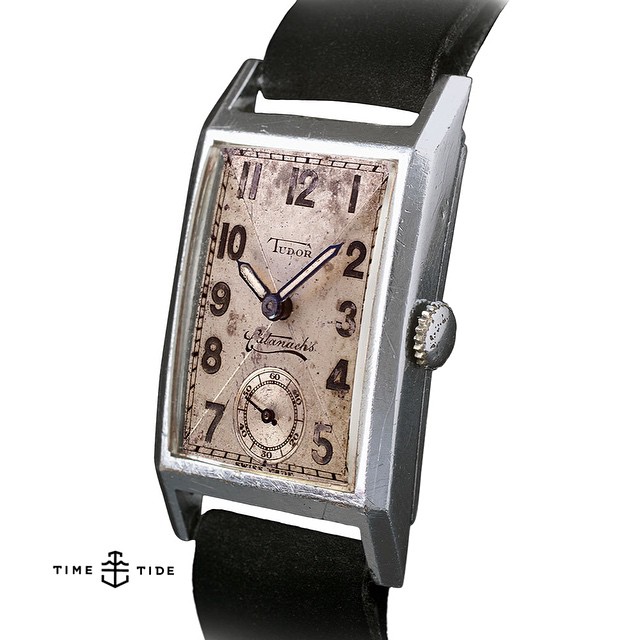 Editor’s note: Not many know it, but Australia was one of the most important markets for Hans Wilsdorf as he built the businesses of Rolex and Tudor in the early part of the 20th century. Tudor watches have been in Australia for the best part of 100 years, proving that Australians know great value when they see it — value the brand continues to offer today. While our American and English cousins have only recently rediscovered the joys of Tudor watches (relaunching in the American market in 2013 and the UK in 2014), Australia can stand proud in the knowledge that we’ve been wearing watches emblazoned with the Tudor shield and Tudor rose for the last 83 years. Tudor first came to Australia in 1932. History shows that it was merely eight years after Hans Wilsdorf registered the trademark “The Tudor” in 1926. The Australian distributor was the jewellery firm Willis & Sons – who had been importing, wholesaling and manufacturing jewellery since 1858. While Australia in the ’30s wasn’t the centre of the watchmaking world, we did have a pretty significant expertise and background in jewellery, thanks to the gold rush – so it’s not entirely surprising that we would…
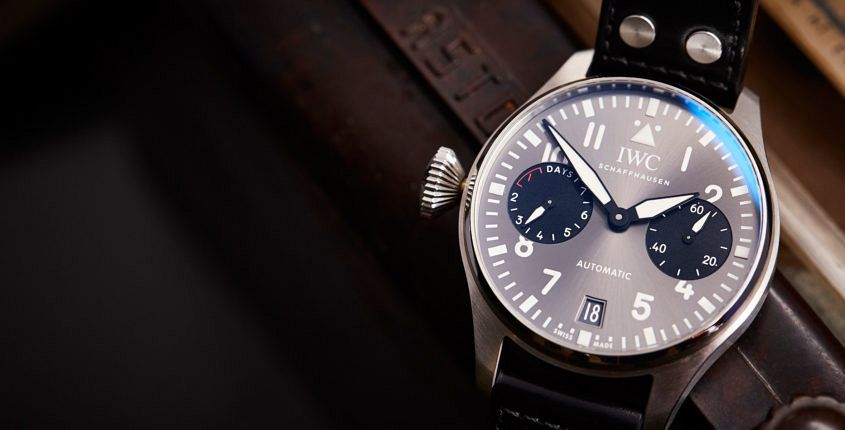 This is one of those watches that makes so much sense I’m amazed it didn’t exist until now. But before we dive into the details of the IWC Big Pilot Edition ‘Right-Hander’, let’s step back and have a quick recap on the Big Pilot. The Big Pilot is a watch with two distinct histories. The first iteration of this story was the original watch, made as a navigational tool for wartime use. In this context, size = clarity and reliability. The civilian story of the Big Pilot begins in 2002, with the reference 5002. IWC’s revival of their historic design was perfectly pitched for the times, as big watches were all the rage, but few had the presence of IWC’s 46mm aviator. Seventeen years on and the Big Pilot is a staple of IWC’s lineup, offered in many material, complication and dial configurations over the years. But never — until now — a right-handed version. Quick primer on right and left-handed watches. Watches are intended to be worn on the less dominant hand, which, for most people, is the left. Ergonomics and good design dictates that a watch worn on the left hand should have its crown on the right…
 If you’re reading this, you probably know who Gérald Genta is, and if you don’t, you probably recognise the name. He was the most prolific watch designer of the 20th century, having been the source of inspiration for the Audemars Piguet Royal Oak, the Patek Philippe Nautilus and the Omega Constellation. He designed for everyone, from Universal Genève and IWC, to Cartier and Bulgari, leaving his fingerprints on the majority of the most loved watches in production today. Considering his level of impact, it is exciting when more detail is uncovered about the artist’s life, which has happened through the Gérald Genta Heritage Association and a retailer Mr Genta had a close relationship with, The Hour Glass. Together they have brought to light a collection of photographs of Gérald Genta taken over several decades in Singapore and Malaysia. The full story can be found at The Hour Glass here.